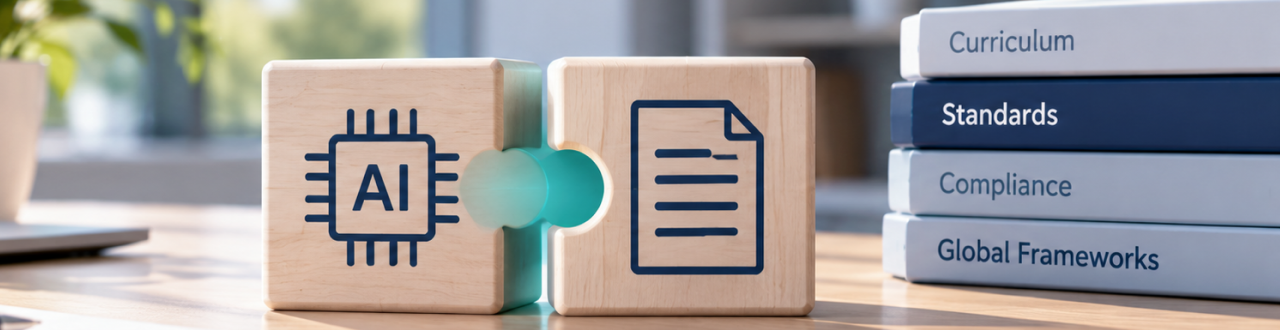
There has been a lot of discussion lately about how artificial intelligence can work with educational standards. As AI becomes more involved in creating content, supporting educators, and building personalized learning experiences, it needs more than a general understanding of standards frameworks. It needs to understand what students are expected to learn and analyze how those expectations are met through authentic assessment.
That has led to some interesting new approaches. Some organizations are building open educational infrastructure that gives AI agents more context by connecting standards with the skills, concepts, and outcomes. By bringing publicly accessible standards frameworks together with learning progressions, curricular resources, and other educational information, these approaches give AI more context for understanding how learning fits together and making connections across that information. The idea is that if AI has a better understanding of how learning is structured, developers can build better educational applications on top of that information.
We think there is a lot of value in that idea. But at EdGate, we are approaching the opportunity from a different direction. Rather than trying to make AI the source of educational materials, we are focused on using AI as a resource to help the people working with standards do more with them.
Standards are more than a list of codes
EdGate has been leading the educational standards market for nearly 30 years. Over that time, we have built a large repository of standards, developed the EdGate Taxonomy, created alignment and crosswalking tools, and worked with organizations that rely on current and accurate standards data to build and maintain their products.
For a publisher or EdTech company, simply having access to standards is not usually the end goal. They may need to author a set of standards, align thousands of pieces of content, work across multiple states and frameworks, identify gaps, compare standards, maintain correlations as standards change, and provide evidence of alignment to customers or adoption committees.
That is where we see AI having a particularly practical role.
Rather than starting with a general-purpose AI model and asking it to determine what an educational standard means or whether content aligns to it, we can provide the AI tool with a more structured foundation to begin its work. With the standards, terminology, and relationships are already there, AI can then help people work through the information more quickly and see connections that were not readily apparent.
Making alignment work more manageable
AutoAlign is one example of how we are using AI to make the alignment process more manageable while keeping the work accurate and meaningful.
Instead of asking someone to manually review every piece of content and determine which standards might apply, the EdGate AutoAlign tool can analyze the content and identify information such as grade level, subject, topics, learning objectives, and key terms. Those insights can then be used to identify relevant concepts within the EdGate Taxonomy and potential standards alignments.
The important part is what happens next. The AI recommendation is not treated as the final answer. It gives the person doing the alignment a much more informed place to start, and those recommendations can be reviewed and refined by someone with standards expertise. At EdGate, it is the expert human that signs-off on the actual standard alignments.
Alignment requires context. A lesson can mention a concept without actually addressing the skill represented by a standard. Two standards can use similar language while expecting very different levels of understanding and lead to two very different outcomes for students. These are the kinds of distinctions that require human judgment.
The goal is to let AI handle more of the groundwork without taking the expertise out of the process.
CTE makes the challenge even more apparent
This becomes particularly relevant as organizations work with standards and frameworks beyond traditional academic subjects. Career and technical education (CTE) provides a good example because CTE standards combine academic knowledge, technical skills, career pathways, industry expectations, and workforce competencies.
For someone developing or managing CTE content, alignment is not as simple as finding a matching phrase in a standards document. There may be several related frameworks to consider (Career Clusters), and understanding how a particular skill fits within a larger pathway can be just as important as identifying and applying the standard itself.
This is where the combination of structured standards data and AI becomes interesting. AI can help surface concepts and potential relationships across large amounts of information, while the people working with the content can determine whether those relationships actually make sense.
As CTE continues to connect education more directly with career and workforce skills, we expect those relationships to become increasingly important and challenging. The solution goes beyond having access to more standards, it requires a system that brings connections to light and allows users to act with confidence.
Two ways of thinking about AI and standards
The growing interest in AI-ready educational data is a sign that the industry is moving beyond the idea of standards as static documents. Standards can be connected to skills, concepts, content, grade levels, subjects, pathways, other frameworks, and even the instructional approaches used to help students develop those skills. Making those relationships easier for technology to understand creates opportunities that were not practical at the same scale before.
There is value in building that kind of educational knowledge infrastructure, particularly for developers who want to build AI-powered learning experiences. There is also value in using AI to improve the operational work that publishers, EdTech companies, and other organizations already have to do with standards every day.
We see these as two related but different applications of the technology.
For EdGate, our focus is on the latter. We want to use AI to make trusted standards data and correlation expertise more useful at scale. That means helping teams analyze content, identify potential alignments, find gaps, and work with increasingly complex standards frameworks without asking AI to replace the people responsible for making those decisions.
That approach is especially important as the standards organizations we work with become more diverse. Academic standards are still at the center of much of the work, but CTE, workforce, international, and other specialized frameworks are becoming increasingly important for the organizations we serve.
AI can help us work across that complexity. It doesn't have to be the authority that defines it.
Where we see this going
We don't think the most interesting question is whether AI will replace the people who work with standards. A more useful question is what those people could accomplish if AI took some of the more time-consuming parts of the work off their plates.
If AI can analyze large collections of content, surface concepts and potential alignments, identify relationships, and help teams find gaps more quickly, standards professionals can spend more of their time reviewing, refining, and making decisions that require actual expertise.
That is the direction we are taking at EdGate. We are not trying to make AI the source of truth for educational standards. We are building on the standards data, taxonomy, technology, and expertise we have developed over decades and using AI to make that foundation more useful.
As standards continue to evolve and become more interconnected, we think that combination of technology and expertise will become increasingly important.
See How AI Can Support Standards Alignment
Curious what this approach looks like in practice? See how ExACT combines AI-powered analysis, the EdGate Taxonomy, standards data, and human review to help organizations align content more efficiently.